

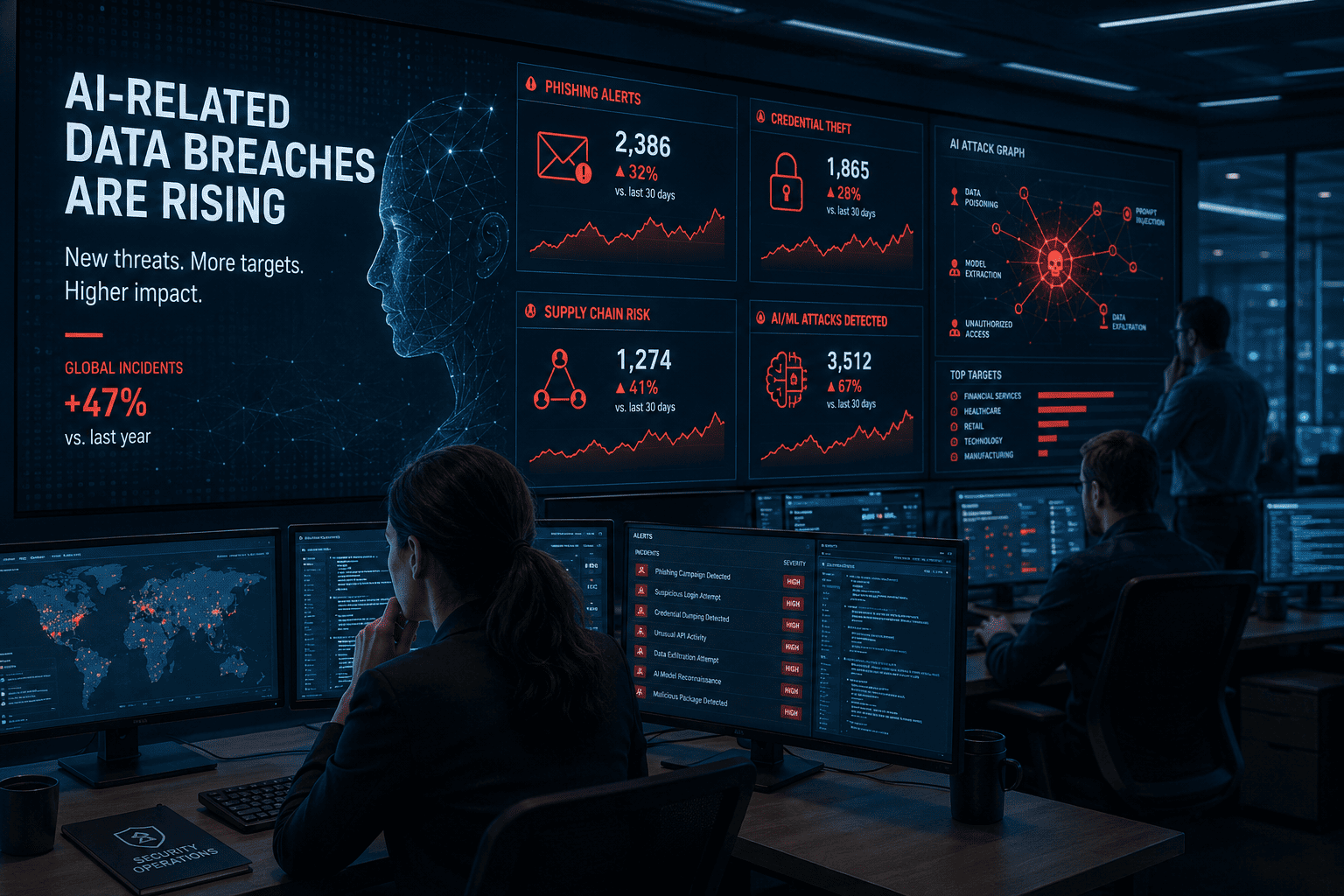
AI is no longer just a productivity story. It is now a breach story too.
Recent reporting and incident data point to the same conclusion: attackers are using AI to scale phishing, sharpen impersonation, automate reconnaissance, and speed up compromise. For businesses, that changes the threat model. The problem is not only that more attacks are happening. It is that fraudulent messages, fake identities, and malicious workflows are becoming cheaper to produce, harder to detect, and easier to personalize.
The latest breach reporting from Verizon and coverage from Reuters suggest a notable shift in the incident landscape: AI-assisted attacks are becoming a more prominent driver of cyber incidents, while traditional stolen-credential narratives are being reshaped by AI-enabled social engineering and automation. At the same time, major AI platform announcements, including those highlighted at Google I/O 2026, show how quickly AI capabilities are being embedded across business software. That combination creates a clear business reality: the attack surface is expanding faster than most security programs are adapting.
What is happening right now
Right now, businesses are dealing with a more industrialized form of cybercrime. Attackers are using generative AI to write convincing phishing emails, mimic executive tone, translate scams into natural local language, and generate realistic lures tailored to specific roles or departments. That means the old signs of fraud, bad grammar, awkward phrasing, obvious formatting issues, are far less reliable than they were even two years ago.
Verizon’s 2026 DBIR reinforces the larger pattern: social engineering remains central to many breaches, and attackers continue to favor methods that exploit human trust because they are efficient and scalable. Reuters’ reporting on the same findings underscores a key concern for businesses: AI-related breach activity is rising quickly enough to change how incidents are classified and discussed. In practical terms, companies are not just seeing more attempts. They are seeing better attempts.
At the same time, businesses are rolling out AI features into search, email, customer support, coding tools, analytics, and document workflows. Every new model integration, plugin, connector, or API adds value, but it can also introduce data exposure, permission mistakes, third-party dependencies, and new routes for abuse.
AI has not replaced classic attack techniques. It has made them faster, cheaper, and more believable.
— Elaitech editorial
Why AI-related breaches are increasing
Attackers have gained scale.
- AI can generate thousands of unique phishing variants in minutes.
- Reconnaissance is faster with automated analysis of public company data, executive profiles, and leaked information.
- Attack chains can be partially scripted, from lure generation to follow-up messages.
Quality has improved.
- Messages sound credible.
- Brand impersonation is cleaner.
- Deepfake voice and synthetic media make executive fraud more plausible.
Defenders are still catching up.
- Many awareness programs still train users to spot outdated scam patterns.
- Legacy email defenses were not built for highly personalized AI-crafted content.
- Identity controls are often inconsistent across SaaS apps, vendors, and contractors.
AI adoption expands risk.
- Employees paste sensitive data into AI tools.
- Teams connect external models to internal systems without full review.
- Supply-chain exposure rises as more vendors embed AI into products and workflows.
The threat is evolutionary, not hypothetical
The most important shift is not that AI created a brand-new category of cybercrime. It is that AI amplifies old attack paths, especially phishing, business email compromise, and account takeover, until they become more effective at scale.
Where businesses are getting hit
The most immediate business risks are showing up in six areas.
- AI-powered phishing and spear phishing. Attackers can customize messages for finance teams, HR staff, legal departments, procurement managers, and executives with very little effort.
- Social engineering and impersonation. Voice cloning, polished pretexts, and synthetic identity signals make urgent requests seem legitimate.
- Credential theft and account takeover. AI helps adversaries refine lures, test credential stuffing patterns, and identify the most promising targets quickly.
- Automated attacks. AI can assist with vulnerability discovery, exploit packaging, and rapid iteration across large target sets.
- Supply-chain exposure. Vendors increasingly embed AI services, agents, and third-party integrations into products. Each dependency can become a trust problem if governance is weak.
- Data leakage through AI usage. Employees may unknowingly expose customer data, internal documents, code, contracts, or strategy material when using unapproved tools.
For many organizations, the breach does not begin with a dramatic zero-day exploit. It begins with a believable email, a fake calendar invite, a copied login page, an over-permissioned integration, or a vendor workflow no one reviewed carefully.
Real-world implications for businesses
Business leaders should care about AI-related breaches for one reason above all: they compress the time between exposure and damage.
If an attacker can generate a convincing phishing sequence in minutes, impersonate an executive, and pivot through a cloud app connected to finance or customer data, the cost is not only technical. It becomes operational and financial very quickly. Businesses face:
- Direct financial loss through invoice fraud, payroll diversion, wire fraud, and ransomware.
- Regulatory exposure when customer, employee, or payment data is mishandled or exfiltrated.
- Brand damage when customers learn that internal controls failed against preventable attacks.
- Downtime and response cost from containment, forensics, legal review, and customer notifications.
- Board-level pressure as AI adoption moves faster than governance, policy, and controls.
There is also a strategic issue. As AI tools become central to product development and internal operations, security failures stop being isolated IT events. They become business model risks.
What businesses should do now
Companies do not need panic. They need tighter controls around identity, communication, vendors, and AI usage.
- Harden identity first. Enforce phishing-resistant MFA where possible, reduce dormant accounts, review privileged access, and limit lateral movement across SaaS platforms.
- Modernize phishing defense. Upgrade email security, add domain protection, monitor lookalike domains, and train staff on AI-generated fraud scenarios rather than outdated spam examples.
- Verify sensitive requests out of band. Payments, payroll changes, credential resets, and vendor banking changes should require secondary verification through a separate trusted channel.
- Create an AI usage policy that is actually enforceable. Define what tools are approved, what data cannot be pasted into public models, and what review is required for new AI integrations.
- Review your AI supply chain. Ask vendors where models are hosted, how prompts and outputs are handled, what data is retained, and what subprocessors are involved.
- Log and monitor AI-connected systems. Treat model APIs, plugins, automation platforms, and agent workflows like sensitive infrastructure, not casual productivity add-ons.
- Exercise incident response for AI-assisted attacks. Run tabletop scenarios for executive impersonation, deepfake fraud, chatbot data leakage, and compromised vendor integrations.
A practical priority
If your team is adopting AI faster than it is reviewing permissions, data flows, and vendor dependencies, you do not have an innovation advantage. You have a governance gap.
Future outlook: expect smarter attacks and stricter expectations
The next phase is not hard to predict. AI models will keep improving at multimodal content generation, real-time interaction, and workflow automation. That means phishing will become more adaptive, impersonation more believable, and attack campaigns more responsive to how a target behaves.
On the business side, AI will continue to be embedded into mainstream products from major vendors. Announcements like those at Google I/O 2026 show where the market is headed: deeper AI integration across tools people already use every day. That will create genuine productivity gains, but it will also push security teams to govern AI inside ordinary business processes rather than treating it as a separate experiment.
The companies that handle this well will do three things consistently: adopt AI deliberately, secure identity relentlessly, and treat vendor and data governance as first-class operational work. Everyone else will keep calling preventable incidents “surprising.”