

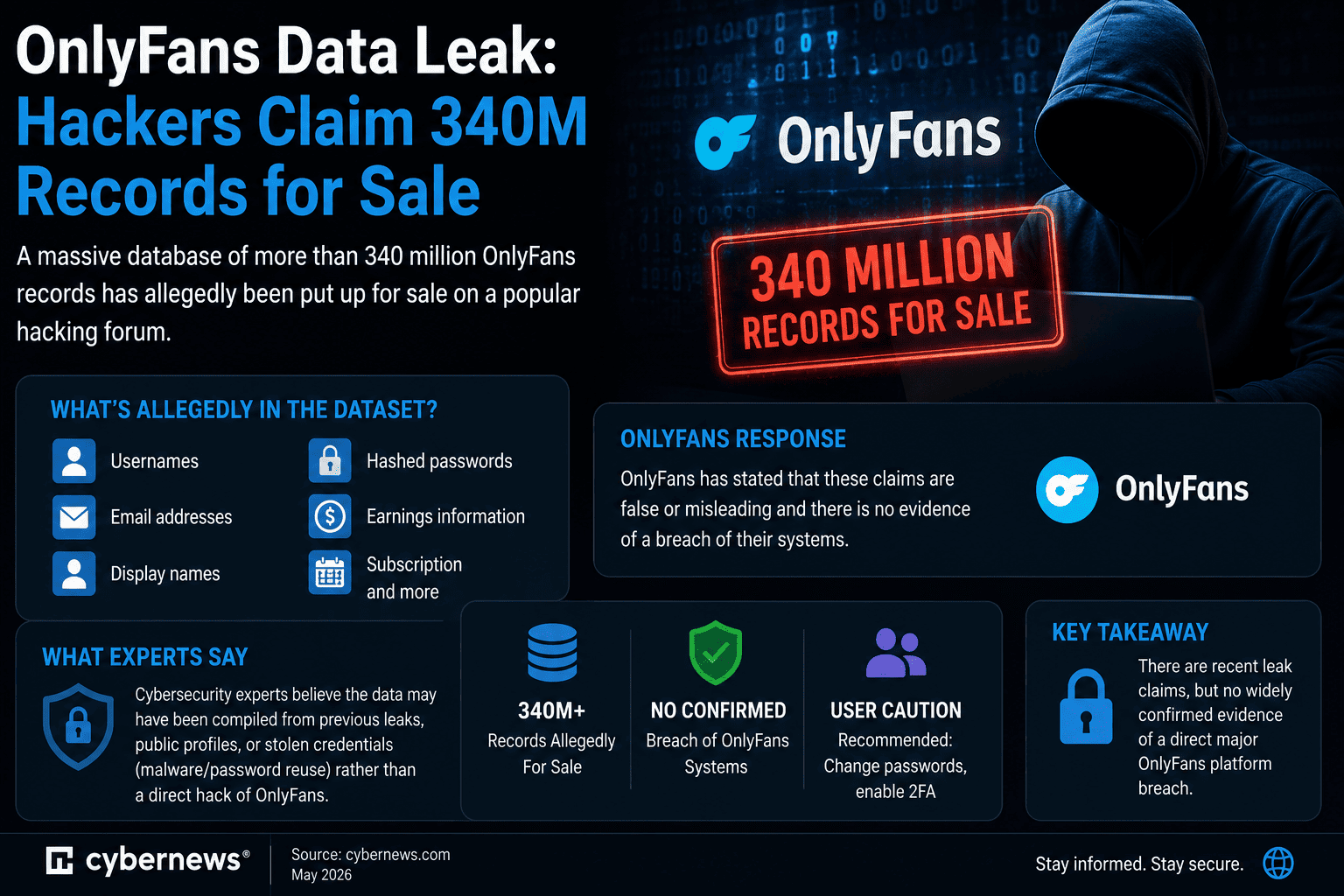
A reported “mega data leak” tied to OnlyFans is exactly the kind of story that spreads fast: a huge number, a high-profile platform, and a vague claim of stolen records. But security teams do not get paid to react to headlines. They get paid to separate evidence from noise, estimate real exposure, and respond in a way that protects users without creating more confusion.
That is the useful lens for this story. Whether the claim turns out to be a fresh breach, recycled data, scraped content, or a mix of sources, the incident highlights a familiar problem: many organizations still struggle to communicate clearly when the facts are incomplete and the public pressure is immediate.
What is being claimed
According to reporting, attackers claimed to hold a large dataset associated with OnlyFans. As with many early-stage breach stories, the first wave of coverage focuses on scale and shock value rather than verification. That is normal, but it is also where readers and companies can make bad assumptions.
A claim is not proof. In breach reporting, there are usually four possibilities:
- A genuine new compromise involving internal systems or third-party providers.
- Old data resurfacing and being repackaged as a new incident.
- Scraped or aggregated data collected from public or semi-public sources.
- A blended dataset that combines leaks from multiple incidents to appear larger and more credible.
Those distinctions matter because the user risk, legal exposure, and response plan are completely different in each case.
Headline size is not incident severity
Do not treat breach claims, forum screenshots, or “sample files” as conclusive evidence. Attackers are good at packaging ambiguity as certainty.
The first question is not “how big?”
In security incidents, scope is important, but provenance is everything.
— Elaitech
When a leak claim appears, the right first question is simple: where did the data actually come from? Without that answer, numbers are mostly theater. A dataset of millions of records sounds catastrophic, but if those records are years old, duplicated, publicly scraped, or disconnected from account access, the risk picture changes immediately.
Security teams should validate:
- whether the sample contains unique internal fields that could only come from the platform,
- whether timestamps suggest a current or historical source,
- whether affected data includes credentials, payment data, private messages, or only profile metadata,
- whether third-party vendors or cloud buckets are part of the chain.
This is also where disciplined communication matters. Users can handle uncertainty. What they do not tolerate is vague reassurance followed by a quiet reversal two days later.
What platforms should do in the first 24 hours
Bad response pattern
- Issue a blanket denial before validation
- Focus on PR wording instead of technical triage
- Ignore third-party exposure paths
- Wait for journalists to define the narrative
Better response pattern
- Preserve evidence and begin provenance analysis
- Compare samples against production and historical datasets
- Review vendor, storage, and scraping vectors
- Publish a narrow, factual holding statement
If a company finds credible evidence behind a leak claim, the first 24 hours should be operational, not theatrical. That means tightening logs retention, isolating suspicious access paths, validating whether there is active intrusion, and identifying exactly which users face meaningful harm.
For consumer platforms, the practical hierarchy is usually clear:
- Protect accounts by forcing resets or step-up authentication where justified.
- Contain data exposure by closing the source, whether that is an app flaw, cloud misconfiguration, insider path, or scraper weakness.
- Notify users precisely about what data may be involved and what they should do next.
- Coordinate legal and regulatory obligations without letting them slow down technical response.
Sensitive platforms have asymmetric risk
If you run a subscription or creator platform, assume attackers value not just credentials and payments but relationship metadata, private communications, and any field that can be used for extortion or doxxing.
Why this story matters beyond one platform
The OnlyFans leak claim is not just a celebrity-platform story. It is a reminder that platforms handling intimate, reputation-sensitive, or financially linked user data operate under a stricter standard. The downstream harm is not limited to spam or credential stuffing. It can include blackmail attempts, targeted harassment, identity exposure, and long-tail reputational damage.
That is why “no payment data was exposed” is never a complete answer. For many users, private associations and communications are the most sensitive assets in the system.
Companies in this category should be investing in:
- segmented data access and strict least privilege,
- strong vendor due diligence and contractual logging requirements,
- better anti-scraping controls and anomaly detection,
- incident communications drafted in advance for partial-information scenarios.
The real takeaway
The mature response to a breach rumor is neither panic nor dismissal. It is controlled verification, fast containment, and user-first communication.
Need a sharper incident response plan?
If your platform handles sensitive user data, we can help you review breach readiness, response workflows, and communication gaps before the next headline hits.
Talk to Elaitech